

Finding the best personal loan in Canada comes down to more than just the interest rate. The right loan for you depends on how much you need to borrow, your credit profile, your income, and how quickly you need access to funds. Whether you’re looking to consolidate debt, cover an unexpected expense, finance a major purchase, or pay for home repairs, there are lenders across Canada offering personal loans for a wide range of financial situations.
In this guide, we’ll compare some of the best personal loans in Canada, explain how they work, outline the requirements to qualify, and help you choose the option that best fits your needs.
Key Points
1. The best personal loan for you depends on factors such as your credit score, income, desired loan amount, repayment term, and funding speed.
2. Banks usually offer the lowest rates, while alternative lenders often provide faster approvals and more flexible requirements.
3. Comparing multiple lenders can save you thousands of dollars in borrowing costs. The APR is the best measure because it includes both interest and lender fees.
4. When choosing a lender, compare the APR, fees, repayment terms, funding speed, and eligibility requirements, not just the advertised interest rate.
5. Approval is about predictability, not size: our data on ~500,000 applications shows that being paid by direct deposit alone makes you ~93% more likely to be funded. And how you earn matters more than how much.
Best Personal Loans In Canada At A Glance: 2026
Filters





What Is A Personal Loan?
A personal loan is a financing option that gives you a lump sum of money upfront, which you repay in fixed installments with interest over a set term. There are very few restrictions on how you can use the funds, which is what makes a personal loan such a flexible tool. The terms you’re offered depend on several factors, including your credit score, income, debt, and any assets you can pledge as collateral.
Here’s what you can generally expect from a personal loan in Canada:
- Loan amounts: Depending on the lender, amounts can range from around $500 up to $50,000 or more. Smaller requests are also the easiest to get approved: in our analysis of roughly 500,000 applications, requests of $10,000 or less had the highest funding rates, and the odds slid as the amount climbed5.
- Interest rate: Personal loan rates are usually lower than credit cards but higher than home equity products. They generally range from 9.99% to 35% APR2.
- Loan term: Terms commonly range from 6 months to 5 years, though they can be as short as 3 months or as long as 10 years.
The best rate you can get depends on your credit score, income, the type of loan (secured or unsecured), the lender (bank, credit union, or alternative lender), and the term. In general, the lowest rates go to borrowers with excellent credit and stable finances, while rates climb toward the 35% cap for those with poor credit.
What Are The Requirements Of A Personal Loan?
Every lender’s process is a little different, but most look at a few key factors when deciding whether to approve you:
- Income: Lenders set a minimum income threshold. Some require a net monthly income of $1,200, others $2,000 or more. You’ll need to provide proof, such as pay stubs or your T4 slip.
- Debt-to-income ratio: Most lenders want to see a ratio no higher than 35%-44%. A higher ratio lowers your chance of approval. Lenders often check this through your bank statements.
- Employment history: Job stability matters. Lenders usually like to see at least 3-6 months with your current employer, and may ask for an employment letter.
- Credit report and score: Your lender will usually ask permission to run a credit check. The higher your score, the less risky you look and the lower the rate you’ll likely get. A lower score signals more risk and usually means a higher rate. Some lenders set a minimum score you must meet.
- Security/collateral: If your credit is less than perfect, a lender may ask for collateral such as a car or home. This added security can unlock better terms, like a larger amount and a lower rate.
Those are the factors lenders say they consider. When we looked at what actually moved funding outcomes across roughly 500,000 applications, a clear ranking emerged5, and the biggest lever is one most people overlook.
Each factor is measured against its own baseline (for example, direct deposit vs. no direct deposit; homeowners vs. renters), so the figures show each factor’s individual effect rather than positions on one shared scale.
Learn more: Study: Who Really Gets Approved For A Loan? Insights From Half A Million Applications
Documents Required To Apply For A Personal Loan
| Document | Details |
|---|---|
| Personal identification | You’ll need to prove your name, date of birth, and address using 1 or 2 government-issued IDs (at least 1 with a photo), such as a driver’s license or passport. |
| Social Insurance Number (SIN) | Some lenders request your SIN to run a credit check. |
| Employment documents | Proof of employment, such as pay stubs, tax forms (T4 slips), or an employment letter. |
| Financial documents | Most lenders require 3 months’ worth of bank statements. |
| Bank account details | You may need to provide a void cheque for direct deposit and for the withdrawal of payments. |
Instant Bank Verification (IBV)
Instant Bank Verification is a digital process that lets lenders instantly and securely verify your bank account details and financial information, including your income, balances, and recent transactions, through a third-party provider like Flinks. IBV benefits both sides: it gives lenders a quick, accurate way to assess your eligibility, and it speeds up your approval while keeping your data secure. With IBV, you don’t need to submit documents; you simply log into your bank account through a secure portal to grant read-only access to your statements.
+93%
Baseline = applicants paid by any non-direct-deposit method (Index 100). If you’re paid by cheque or e-transfer, switching to direct deposit before you apply is one of the most powerful moves you can make.
Can You Get A Personal Loan With Bad Credit (550 and below)?
If your credit score is below 550, getting a loan from a traditional bank is difficult and often leads to rejection. Credit unions may approve you, but typically at higher rates than they offer prime borrowers, and you need to be a member. A more realistic option is a private lender. They often cater to borrowers with fair-to-bad credit and have much more flexible requirements.
Do note that bad credit loan options generally have higher rates, but are easier to get approved for and have faster application and funding times.
Good News!
If you have bad credit, don’t assume getting approved is out of reach. While borrowers with stronger credit are approved more often, our analysis of roughly 500,000 applications shows that many people with low credit scores still successfully qualify for loans. For example, those with low credit were funded more than half as often as the best group (fair credit)5. In this part of the market, bad credit narrows your odds; it doesn’t shut you out.
Can You Get A Personal Loan With Low Income?
Even on a low income, there are still ways to qualify for a personal loan, though your approval odds depend on the lender’s criteria. Generally, you’ll have better odds with a private lender, since they have less strict requirements and may accept lower income levels, and some will even count non-employment income such as government benefits or pension payments. That said, you’ll still need to prove you can cover the payments, so you may have to settle for a smaller loan amount. The amount you request shouldn’t be more than your income can comfortably handle.
Stability matters more than the size of your paycheque. If your income is on the lower side, this is the most encouraging finding in our data: how you earn separates applicants more than how much you earn5. The gap in funding likelihood between income types (a full-time worker versus an unemployed applicant) is wider than the gap between the lowest and highest income levels. In other words, a steady, verifiable paycheque, even a modest one, can outweigh a larger but less predictable income.
The gap created by how you earn is about 1.3x wider than the gap from how much. Index 100 = the overall average funded rate; a higher number means funded more often.
This even holds for part-time work. A part-time paycheque is often treated as second-best, but it was the only income type that could out-qualify full-time workers, as long as the pay arrived by direct deposit. A part-time worker paid by direct deposit was about 36% more likely to be funded than a full-time worker who wasn’t5.
Baseline = full-time applicants without direct deposit (Index 100). Part-time + direct deposit = 136.
Best Places To Get A Personal Loan With Bad Credit (Under 559)
Private lenders operate outside the traditional banking system and aren’t subject to the same strict regulations banks must follow. That gives them more freedom in their loan criteria. They’re often more open to working with bad-credit borrowers or those with non-traditional income, making them a more accessible option for those with bad or fair credit.
A private lender may be the right fit when:
- Your credit is below what banks accept. If your score is under 660, the Big 5 will almost always decline. Private lenders are built for borrowers with past defaults, recent collections, or a thin credit file.
- You need emergency funds quickly. Private lenders can often approve and deposit funds within 24 to 48 hours through a fully digital process, which is useful for emergency car repairs, medical bills, or other time-sensitive expenses.
- You need a smaller loan amount. Most banks set a minimum of $2,000 to $5,000. If you only need a small amount, private lenders and cash advance apps often offer quick access to cash.
- You want a fully online application. Private lenders mainly operate online, so you can apply, upload documents, and receive funds without leaving home.
Some alternative lenders don’t even require a credit check, basing your eligibility on your overall financial health instead. Just keep in mind that these lenders charge higher interest rates, making them a more expensive option.
Don’t Overlook Credit Unions
If you’re a member of a credit union like Meridian (Ontario), Coast Capital (BC), Vancity, Servus (Alberta), or Desjardins (Quebec), check their personal loan rates before applying to a Big 5 bank. Because credit unions are member-owned and not-for-profit, they routinely beat bank rates by 1-2 percentage points and can be more flexible on debt-service ratios. The trade-off is that you generally need to be (or become) a member first.
Best Places To Get A Personal Loans With Good Credit (660+)
If your credit score is 660 or higher and you have steady employment income, you’re in the strongest possible position to borrow. With good credit, you can qualify for the lowest rates in Canada from a traditional bank or a credit union.
Top Big 5 Bank Personal Loans
| Bank | Personal Loan Details |
|---|---|
| RBC Royal Bank | The RBC Personal Loan is available with either a fixed or variable interest rate, and you can switch from a variable to a fixed rate during the term. You can also pre-pay the loan at any time without penalty. |
| TD Bank | The TD Personal Loan starts at $2,000 with terms from 1 to 7 years, in either a fixed or variable rate. Optional TD Loan Protection insurance can pay off or reduce the loan balance in the event of death or total disability. |
| BMO | The BMO Personal Loan Plan is BMO’s standard personal loan product, offered with a fixed interest rate and the option to add Personal Loan Plan Insurance at the time of application. |
| CIBC | The CIBC Personal Loan lets you choose your term, payment frequency, and either a fixed or variable interest rate. Variable rates are tied to CIBC Prime. |
| Scotiabank | The Scotia Plan® Loan offers terms of up to 5 years, your choice of a fixed or variable rate, and no prepayment penalties. Payment frequency is flexible (weekly, bi-weekly, or monthly), and you can postpone one payment per year. |
How To Apply For A Personal Loan
Every lender’s process is a little different, but here’s what you can generally expect.
Step 1. Find the lender’s application. Whether you’re applying with a bank or an alternative lender, you can usually start online, though in-person applications may also be available.
Step 2. Fill in the application. You’ll be asked to provide:
- Personal identification (full name, date of birth, SIN)
- Contact information (address, phone number, email)
- Employment information (where you work, your job title)
- Income information (pay stubs, or bank statements to prove direct deposit amounts)
- Other financial information, such as your current debt and assets
Many online lenders use instant bank verification (IBV) here, so no documents are required. You simply log into your bank account through a secure portal.
Step 3. Submit and wait for a response. Approval can take anywhere from a couple of hours to a couple of days. If you’re approved, you’ll receive your loan agreement. Read it carefully before you sign.
Step 4. Receive your funds. Most lenders deposit the loan directly into your bank account via electronic funds transfer (EFT). Some smaller lenders send the money by e-transfer.
How A Personal Loan Broker Can Help You Find The Best Loan
A personal loan broker is a service that submits a single application against a network of lenders and returns matched offers. You don’t pay the broker directly. They’re paid by the lender that funds your loan.
When A Broker Is The Right Move
- You don’t know which lender will approve you. Applying to five lenders directly means five hard credit pulls, which can drop your score by 15-30 points and signal financial distress to other lenders.
- Your credit is in the fair-to-bad range. Brokers know which lenders are realistic for your profile and route your application accordingly, instead of you guessing.
- You want to compare offers quickly. A good broker can return multiple lender matches within minutes of submission.
- You want one set of paperwork. You submit your documents once instead of five times.
What To Expect From A Reputable Canadian Broker
- Soft credit check first: you get matched without a hard pull on your credit.
- No upfront fees: payment comes from the lender, not from you.
- A transparent network: the broker discloses which lenders they work with.
- Licensing: the broker is provincially registered where applicable.
When To Skip The Broker And Go Direct
- If you already have a strong banking relationship and qualify for prime rates, apply directly to your bank.
- If you want a specific product, like a particular credit union’s member loan, apply directly.
- If you’ve already shopped around and have a written offer, use it as your negotiating benchmark with one or two direct applications.
Learn more: Personal Loan Brokers In Canada: Costs, Pros & How To Choose
Types Of Personal Loans In Canada
There are two main types of personal loans, and one may suit you better than the other depending on your credit and whether you have an asset to pledge.
Secured Personal Loans
A secured personal loan requires you to offer up one or more assets as collateral, such as a car or your home. This reduces the lender’s risk because it gives them a way to recover their money if you default.
- Pros: A secured loan often gives you a better chance of approval, a larger loan amount, and a lower interest rate.
- Cons: If you fall behind and can’t make your payments, the lender has the right to seize the asset and sell it to recoup what you owe.
A home helps even if you don’t pledge it. A home is the classic asset behind a secured loan, but our data shows that simply being a homeowner lifts your approval odds, whether or not you put it up as collateral. Across roughly 500,000 applications, homeowners were funded about 29% more often than renters5, and the lift is largest for those on a fixed income.
+62%
+26%
+20%
+10%
+1%
-4%
-3%
A home helps most when it’s backing up a modest-but-fixed income, retirees and benefit recipients see the biggest boost, while it barely moves the needle for part-time or unemployed applicants, whose home is also an ongoing expense.
A home helps most when it’s backing up a modest-but-fixed income, retirees and benefit recipients see the biggest boost, while it barely moves the needle for part-time or unemployed applicants, whose home is also an ongoing expense.
Unsecured Personal Loans
An unsecured personal loan works the same way as a secured loan, except it doesn’t require collateral.
- Pros: If you default, the lender may charge fees or sell your debt to a collection agency, but it can’t seize your assets to recover payment.
- Cons: Unsecured loans generally come with higher rates than secured loans, and they can be harder to qualify for, especially with bad credit. Depending on the size of the loan, you may need a co-signer to get approved.
Learn more: Unsecured Personal Loans
Pros And Cons Of A Personal Loan
Before you apply, it’s worth weighing the advantages and drawbacks of a personal loan.
Pros
- Flexibility: You can use a personal loan to cover almost anything, with very few restrictions on how the money is spent.
- Spread out your costs: A personal loan lets you spread a large expense over months or years. You can also use one to consolidate higher-interest debts and lower your overall payments.
- Accessibility: Personal loans are one of the most common credit products in Canada. With hundreds of lenders, you can often get one even with subprime credit or unstable finances.
Cons
- Interest costs: Rates can climb as high as 35% APR, which makes a personal loan an expensive option in some cases.
- Impact on your credit: If you miss payments or default, your credit score can take a hit.
Learn more: Personal Loan Pros And Cons
How To Get The Best Personal Loan Rate
The advertised “starting rate” on a lender’s website is rarely the rate you’ll be offered. Lenders quote rates based on your credit score, debt-to-income ratio, employment stability, loan term, and, for secured loans, collateral. You can influence most of these, sometimes within weeks.
Strengthen Your Credit Before You Apply
- Pay down revolving credit utilization to under 30% of your limit. This single move can help lift your credit score.
- Don’t open or close credit accounts in the 60 days before applying. New inquiries lower your score, and closing old accounts shortens your credit history.
- Keep active accounts open and in good standing. A thin or empty credit file is a real disadvantage. In our data, applicants with no active unsecured debt were funded about 49% less often than average5, because lenders have little history to score. (This isn’t a reason to take on debt, just to keep the accounts you have healthy.)
- Dispute errors on your credit report. Pull your free reports from Equifax and TransUnion at least a month before applying so your score isn’t being dragged down by mistakes.
Consider A Secured Loan If You Have An Asset
Pledging a car, home equity, or savings as collateral typically drops the APR by 5-10 percentage points. The trade-off is that the lender can seize the asset if you default. If you have strong repayment confidence, a secured loan is the cheapest legal way to borrow outside a mortgage.
Negotiate The Offer You Receive
A pre-approval from one lender is leverage against another. If a bank offers you 10%, taking that offer to your credit union or a broker often produces a counter-offer 0.25% to 1.00% lower.
Learn more: Best Personal Loan Interest Rates In Canada
The Real Cost Of Choosing The Wrong Lender
Comparison isn’t theoretical. It’s the difference between a manageable loan and a punishing one. Here’s the math on a $10,000 personal loan over 60 months at two realistic rate points.
| Lender Type | APR | Monthly Payment | Total Interest | Total Cost |
|---|---|---|---|---|
| Good-credit borrower (bank/credit union) | 9.99% | ~$213 | ~$2,764 | ~$12,764 |
| Alternative lender | 30.00% | ~$324 | ~$9,412 | ~$19,412 |
The figures above are for illustration purposes only. Actual rates, monthly payments, and total costs will depend on your credit profile, the lender, the loan term, and prevailing market conditions at the time of borrowing.
The difference between these two scenarios is roughly $6,600 in interest on the same $10,000 loan. That’s enough to fund an emergency savings account, pay down credit-card debt, or simply stay out of the next loan altogether. Comparison is the single highest-ROI hour you can spend before signing.
Your Personal Loan Checklist: 9 Steps Before You Sign
Work through this list before you sign any loan, whether it’s from a private lender, an online lender, a bank, or a credit union.
- Pull your credit score from Equifax, TransUnion, or your bank’s free portal so you know which lender tier is realistic.
- Calculate what you actually need: borrow only the amount required, not the maximum approved. Every extra dollar is interest.
- Decide on the term: shorter terms cost less in interest; longer terms mean smaller monthly payments. Aim for the shortest term you can afford.
- Get at least two pre-approvals using soft credit checks (a broker can do this in one step).
- Compare APR, not the headline rate: APR includes fees and gives you the true cost of borrowing.
- Read the contract for fees: origination, prepayment, late payment, NSF, and discharge. Add them up.
- Confirm prepayment terms: some lenders charge a penalty for paying off the loan early. Avoid these if you might come into extra cash.
- Verify the lender is licensed in your province and ideally a Canadian Lenders Association member4. Confirm all fees are deducted from the loan proceeds, never charged upfront before approval, and that the APR, term, total cost of borrowing, and payment schedule are disclosed in writing before you sign.
- Don’t sign on the spot. Take 24 hours to review the contract. A reputable lender will honour the offer for at least 48 hours.
If you can check all 9 boxes: you’re ready to sign, and you’ve protected yourself from the most expensive mistakes.
If you can check 6-8: finish the remaining items first. Most take less than an hour each.
If you can check fewer than 6: step back. You’re not ready to commit to a multi-year loan.
Your Personal Loan Borrowing Rights
As a borrower in Canada, you have certain rights in how lenders treat you. Lenders are required to clearly disclose the costs and terms of your loan. They also face limits on what they can charge, and there are restrictions on how they collect repayments3. For example:
- Fee disclosure: Lenders must give you details of all costs and loan terms, including interest rates, fees, and the repayment schedule, before you sign the contract.
- Fair collection practices: Lenders can’t harass you when collecting unpaid amounts. Some collection practices are allowed and others are prohibited.
- Right to cancel: Some loans let you cancel the agreement within a set period without penalty. This cooling-off period is usually around 48 hours after acceptance, depending on the province and loan type.
- Interest rate limits: In Canada, the APR on a high-cost personal loan can’t exceed the criminal interest rate of 35% APR3.
You also have responsibilities: you’re required to repay the loan according to your agreement, and you owe it to yourself to manage your debt so you don’t overleverage and end up spiralling.
Can You Take Out Two Or More Personal Loans?
Unlike payday loans, there’s no limit on how many personal loans you can take out. That said, it’s rarely a good idea to take on too much debt at once. Every additional loan puts more strain on your finances and your ability to keep up with payments.
When Is A Personal Loan A Good Choice?
A personal loan can be a great option when you need flexibility and a lower rate than other borrowing options offer. You can use the funds for unexpected expenses, large purchases, or debt consolidation, all with a predictable, fixed repayment structure. Here’s how a personal loan stacks up against three common alternatives.
Personal Loan Vs. Payday Loan
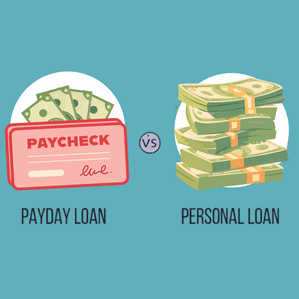
A personal loan is usually the better choice. It offers lower interest rates and longer repayment terms, which makes it more affordable and easier to repay. Payday loans come with very high fees and short repayment windows, making them expensive and hard to pay back by the due date. You can also borrow much more with a personal loan, upwards of $50,000, versus a typical $1,500 cap on payday loans.
Personal Loan Vs. Credit Card
Personal loans generally carry lower interest rates than credit cards, which makes them more cost-effective. You also get a lump sum upfront, which is useful for large expenses, plus a fixed repayment structure. Credit cards, by contrast, can be hard to manage if you’re not disciplined, and balances can snowball into high-interest debt.
Personal Loan Vs. Line Of Credit
A personal loan gives you a lump sum upfront and a fixed repayment term, making it more predictable than a line of credit, which has a flexible limit, a variable rate, and a less structured repayment plan. A line of credit can be useful as a financial backup for occasional extra funds, but a personal loan is the better fit when you need a large sum for a specific expense and prefer steady, consistent payments.
Learn more: Personal Loan Vs. Line of Credit: How Do They Compare?
Personal Loan Vs. Buy Now, Pay Later (BNPL)
A personal loan gives you a lump sum upfront that you can use for almost any purpose, while Buy Now, Pay Later (BNPL) lets you split the cost of a specific purchase into a series of smaller payments. BNPL can be a convenient option for smaller purchases and often offers interest-free promotions, but loan amounts are limited and missed payments can result in fees. A personal loan is generally the better choice when you need to borrow a larger amount, want longer repayment terms, or need funds for expenses beyond a single purchase.
Learn more: BNPL Vs. Personal Loan? Here’s Why Personal Loans Win


Bottom Line
Choosing the right personal loan in Canada comes down to understanding your needs and comparing lenders carefully. If you need a lump sum for a large expense and want a fixed repayment schedule and a lower rate than a credit card or payday loan, a personal loan may be the right fit. With more digital-first options and competitive rates than ever, you have plenty of opportunities to find a loan that suits your situation, so take the time to evaluate terms, fees, and flexibility, compare the APR rather than the headline rate, and you’ll secure a loan that supports your goals and keeps your finances on track.
Frequently Asked Questions
How Fast Can You Get A Personal Loan In An Emergency?
How do I apply for a personal loan?
How much money can I get from a personal loan?
What credit score do you need for the best personal loan rates?
What actually improves your chances of getting approved for a personal loan?
How long will it take to get my personal loan?
Should you get a secured or unsecured personal loan?
Do I need to provide an upfront payment to get my loan?
I have bad credit, can I still get a personal loan?
References
- Bank of Canada. (2026). Posted interest rates offered by chartered banks. https://www.bankofcanada.ca/rates/banking-and-financial-statistics/posted-interest-rates-offered-by-chartered-banks/
- Statistics Canada. (2025). Interest rates on consumer loans, October 2025 release. https://www150.statcan.gc.ca/
- Financial Consumer Agency of Canada. (2025). Personal loans: Borrower rights and lender obligations. https://www.canada.ca/en/financial-consumer-agency/services/loans/personal-loans.html
- Canadian Lenders Association. (2025). Member directory and lending standards. https://canadianlenders.org/
- Correia, P. (2026). Study: Who Really Gets Approved For A Loan? Insights From Half A Million Applications. Loans Canada. https://loanscanada.ca/stats/study-who-really-gets-approved-for-a-loan-insights-from-half-a-million-applications/
®Fairstone Financial Inc. is a wholly owned subsidiary of Fairstone Bank of Canada.
*Interest rates are subject to change. Actual Annual Percentage Rate (APR) varies based on the province of residence and individual factors like credit details and loan amount. The interest rate on an unsecured personal loan is 31.99% in BC.
†On approved credit. Terms and conditions apply. Interest rates vary by province/territory and from customer to customer based on factors like credit score and borrowing history. See Fairstone’s website for details.
Fairstone Financial Inc. holds high-cost credit licenses in AB, MB (License #85047, expiring 20-02-2026) and QC; it has applied for a high-cost credit grantor license in NL. For license information by province, visit Fairstone.ca/HCCG
In Ontario, Fairstone Financial Inc. is licensed as mortgage brokerage 10821.
In Nova Scotia, Fairstone Financial Inc. is licensed as mortgage lender #2021-3000028.