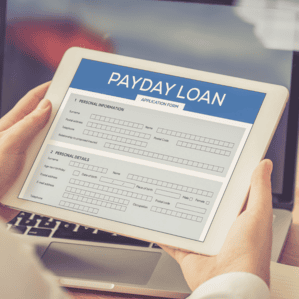



Payday loans can come in really handy when money is tight between paycheques and you’ve got a pressing expense to cover. But as convenient as they may be, payday loan rates are notoriously high, making payday loans among the more expensive financing options available.
Thankfully, recent regulations have been adopted that restrict lenders from charging over a certain amount for high-cost credit products. But still, payday loans continue to be a very expensive borrowing option for Canadians.
Key Points
1. Payday loans are among the most expensive borrowing options in Canada.
2. In Canada (except Quebec and the territories), payday loans cost up to $14 per $100 borrowed — the equivalent of roughly 365% APR on a two-week loan.
3. Before applying for a payday loan, consider other options, such as personal loans or cash advances.
Payday Loan Cost Calculator
Payday Loan Cost Calculator
See what a payday loan really costs before you borrow.
$14 per $100 is the maximum cost in every province except Quebec and the Territories, where different rules apply.
Estimates only. Actual costs depend on your province and lender.
What Is A Payday Loan?
A payday loan is a lump sum of cash (usually $100 – $1,500 maximum) that you can borrow in most parts of Canada. Normally, this type of loan comes with fast approval, easy requirements, and a short repayment term following the deposit of your funds.
One of the most important points to note is that payday loan interest rates in Canada are very high, making payday loans one of the most expensive forms of financing.
Warning: Payday Loans Are Expensive
Payday loans are extremely expensive and can result in a cycle of debt if you cannot repay the full loan amount by the term end date. Consider alternatives to payday loans before deciding.
Payday Loan Features
| Loan Amounts | Up to $1,500 |
| Terms | Up to 62 days |
| Cost | $14 per $100 borrowed; 35% AIR in Quebec and the territories |
| Repayment | One lump sum |
How Much Do Payday Loans Really Cost In Canada?
The maximum borrowing rate that payday lenders can legally charge varies by province. That said, almost all provinces in Canada have regulations that cap payday loan charges to $14 per $100 borrowed.
Here’s a chart to show you the real costs of payday loans:
Maximum Cost Of A $100 Payday Loan By Province
| Province | Max cost per $100 borrowed | Max Penalty for Returned Cheque | Cooling Off Period | Loan Rollover or Extension |
| Ontario | $14 | $20 | 2 business days | Not allowed |
| British Columbia | $14 | $20 | 2 business days | Not allowed |
| Alberta | $14 | $20 | 2 business days | Not allowed |
| New Brunswick | $14 | $20 | 48 hours (not including Sundays and holidays) | Not allowed |
| Manitoba | $14 | $20 | 48 hours (not including Sundays and holidays) | Allowed |
| Saskatchewan | $14 | $25 | Next business day | Not allowed |
| Nova Scotia | $14 | $20 | Next business day (or 2 days for online payday lenders) | Not allowed |
| Newfoundland and Labrador | $14 | $20 | 2 business days | Not allowed |
| Prince Edward Island | $14 | $20 | 2 business days | Not allowed |
| Quebec | 35% AIR | $20 | 10 days | Not allowed |
How Payday Loan Rates Translate To APR
While payday lenders advertise costs as $14 per $100, this doesn’t truly reflect the actual annual cost of the loan. When converted to APR (annual percentage rate), payday loans can cost up to 365%, based on a typical 14-day repayment term.
Since payday loans are short-term (often 14 days), the interest rate appears extremely high compared to traditional financing products like personal loans or credit cards. This is one of the main reasons why you should only apply for a payday loan as a last resort.
How To Calculate The Cost Of A Payday Loan
According to the payday loan interest rates above, here’s what you could pay to borrow different-sized payday loans with a 14-day term in Canada:
| Loan Amount | $100 | $300 | $500 | $700 | $1,000 | $1,500 |
|---|---|---|---|---|---|---|
| All provinces (except Quebec & territories) | $114 | $342 | $570 | $798 | $1,140 | $1,710 |
| Quebec & territories | $101 | $304 | $507 | $709 | $1,013 | $1,520 |
Why Payday Loans Are So Expensive
Payday loans are very expensive because of the higher risk lenders take on. Many payday loan borrowers have low credit scores or urgent financial needs, increasing the likelihood of default. To offset this risk, lenders charge much higher fees.
Plus, payday lenders don’t typically require collateral or credit checks, making these loans more accessible — but also more expensive — than traditional financing options.
Other Costs To Consider When You Can’t Pay Back Your Payday Loan
Ultimately, if you can’t afford to pay back your full payday loan by the time your term finishes, the lender could tack on some hefty late penalties too, such as:
- Fee for a dishonoured cheque or pre-authorized debit: When making your loan payment, most payday lenders accept cheques or pre-authorized debits. However, if your cheque bounces (gets returned) or your pre-authorized debit doesn’t go through, your payday lender can charge you a fee of up to $20.
- Non-sufficient funds (NSF) or overdraft fee: If there isn’t enough money in your bank account when a payday lender tries to withdraw your payment, your bank may penalize you with an NSF fee.
- Additional interest on unpaid debt: In some provinces, payday lenders can charge you additional interest on the amount you still owe — up to 2.5% interest per month on outstanding loan amounts. When coupled with your original rate, that can drive up the final cost of your payday loan.
Non-Financial Costs To Consider With Payday Loans
Before you borrow a payday loan anywhere in Canada, there are some other important costs that you should consider:
- Potential damage to your credit score: While payday lenders do not require credit checks or report payments to the credit bureaus, they can impact your credit scores if you default on your loan. If you want to keep an eye on your credit, check out a free credit score provider like CompareHub. You can also read more about exactly how payday loans affect your credit.
- Legal consequences: If you keep avoiding your payday loan debt, the lender or collection agency may decide to file a lawsuit against you. Not only could this lead to your wages being garnished, but you might also be forced to enter a debt management program or declare bankruptcy when you owe enough money.
These consequences can have a serious negative impact on your creditworthiness and finances as a whole.
How Payday Loans Can Lead To A Debt Cycle
One of the biggest risks of payday loans is the potential for a “debt cycle.” This happens when you’re unable to repay the full loan amount on time and must take out another loan to cover the first.
Over time, repeated borrowing can lead to the following:
- Accumulating fees and interest charges
- Increased financial stress
- Difficulty covering essential living expenses
This cycle of debt can be tough to break and may require professional help, such as credit counselling or a debt management program.
How Much Do Canadians Rely On Payday Loans?
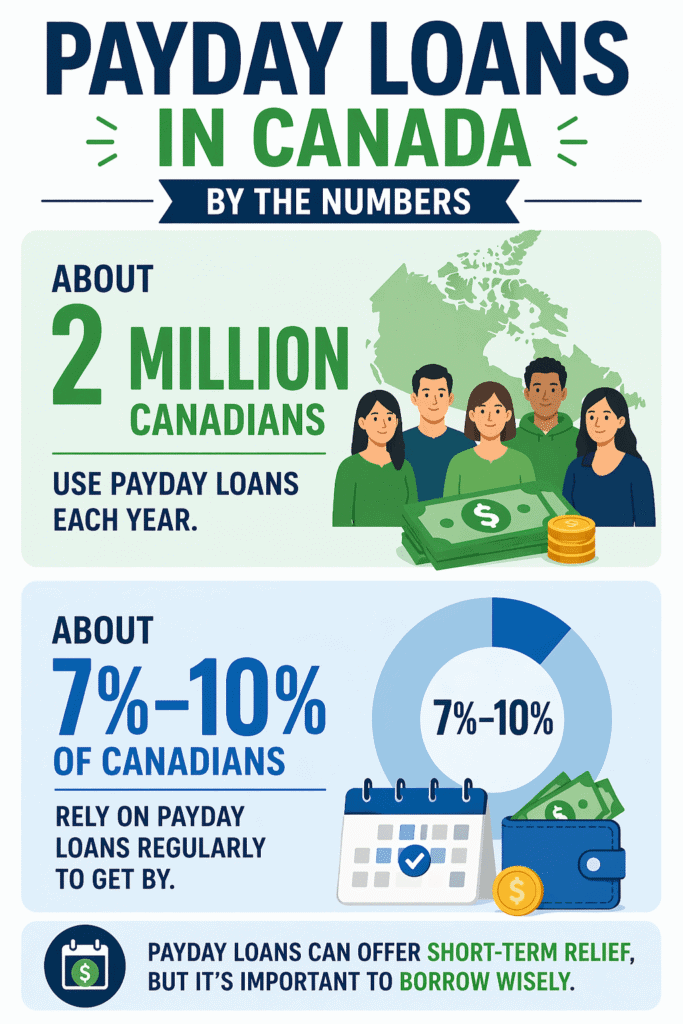
Cost Of A Payday Loan Vs. Alternative Loan Options
Remember, payday loan interest rates in Canada are high. This is one of the main reasons to avoid them unless they’re absolutely necessary. For instance, if your only problem is bad credit, you’re probably better off using a credit card cash advance or a bad credit personal loan.
Let’s illustrate how payday loans compare to other loan options using a few examples:
| Loan Type | Loan Amount | Cost To Borrow | Term | Total Loan Cost |
|---|---|---|---|---|
| Payday Loan | $1,000 | $14 per $100 ($140 interest) | 14 days | $1,140 |
| Cash Advance | $1,000 | 23% APR + 4% service fee ($58.90) | 30 days | $1,058.90 |
| Personal Loan | $1,000 | 25% APR ($74.17) | 6 months | $1,074.17 |
As you can see, the cheapest product is the credit card cash advance; however, the personal loan allows you to pay off your $1,000 over a longer period. Moreover, even though the personal loan payment term is longer, it ends up being much cheaper than the payday loan too.
Can You Carry Multiple Payday Loans At Once?
Yes, you can have more than one payday loan at the same time in Canada, but not with the same lender, because provincial rules prohibit rollovers.
Whether you can borrow from multiple lenders depends on each lender’s approval process, though it’s generally safer to repay your existing loan first. Here’s a closer look at whether you can have two payday loans at the same time.
How To Choose A Payday Lender
If you absolutely need to borrow a payday loan, make sure you do your research and find a reputable lender. Here are some of the main things to look out for when choosing a payday lender:
- Transparency: In Canada, lenders must clearly disclose their loan costs. If a payday lender avoids your questions, refuses to tell you about the potential costs, or doesn’t display those details in their contracts and advertisements, don’t sign up with them.
- Communication: Your lender should also be easy to contact. A legitimate lender will always provide their phone number, address, and email without hesitation. It’s even better if they have a live chat feature or 24/7 customer service line. If they don’t provide those elements online or over the phone, it can be a red flag.
- Licensing: Payday lenders must be licensed to work in the province where they lend. Their licence number should be clearly displayed on their storefront or website.
- Quick approval: Good payday lenders will also have easy requirements and speedy deposit times of 1 or 2 business days maximum. After all, payday loans are meant for emergencies. If you’re really in a bind, you might want to visit a physical payday loan store, or compare the different types of payday loans and payday loan apps that can make same-day deposits.
Regulations And Consumer Protections In Canada
Payday lending in Canada is regulated at the provincial level to protect you from excessive fees and predatory practices.
Key protections include the following:
- Caps on borrowing costs
- Mandatory cooling-off periods allowing you to cancel a loan without penalty
- Restrictions on loan rollovers
- Limits on penalty fees and collection practices
These rules are designed to reduce the financial burden on borrowers and promote transparency in lending.
Learn more: Payday Loans: Know Your Rights
Alternatives To Payday Loans In Canada
Before choosing a payday loan, consider these lower-cost alternatives to payday loans:
- Personal installment loans — Personal loans offer lower interest rates and flexible repayment terms, and can be repaid over several months or years.
- Credit card cash advances — Credit card cash advances are typically cheaper than payday loans, though rates are higher than purchase rates.
- Lines of credit — A line of credit allows you to borrow only what you need and pay interest only on the amount used.
- Borrowing from family or friends — If possible, ask a friend or family member to help out temporarily. This can help you avoid interest altogether, though it’s important to set clear repayment expectations.
- Employer pay advances — Some employers offer early access to earned wages without high fees. Ask your employer if such an option exists.
Do Payday Loans Affect Your Credit Score?
Most payday lenders in Canada don’t run credit checks, so applying for these loans won’t affect your credit score. Plus, payday lenders don’t report your payments to the credit bureaus, which means these loans won’t help or hurt your credit if you repay on time.
However, if you fall behind and the debt is sent to collections, that information can appear on your credit report and negatively impact your score. So payday loans can still hurt your credit if things go wrong.
When A Payday Loan Might Make Sense
While generally not recommended, payday loans may be appropriate in very specific situations:
- You need immediate cash for an emergency expense
- You have no access to cheaper credit options
- You are certain you can repay the loan on time


Final Thoughts
Payday loans can seem like the answer to your prayers when you’re down on your luck and need money in a hurry. But before you accept the money, you should think about the real cost of taking out that loan. More often than not, an installment loan is so much cheaper and a far better alternative that will keep you from falling into a continuous cycle of debt.
Payday Loan FAQs
Can I get a 1-month payday loan?
Should I use an installment loan or a payday loan?
What interest rates do payday lenders charge?
What do I need to get a payday loan?
What’s the maximum penalty fee a payday lender can charge for insufficient funds and bounced cheques?
Can I get a 3-month payday loan in Canada?
Can I have more than one payday loan at the same time?
References
- Government of Canada. (2024). Criminal Interest Rate Regulations (SOR/2024-114). Canada Gazette, Part II. https://gazette.gc.ca/rp-pr/p2/2024/2024-06-19/html/sor-dors114-eng.html
- Financial Consumer Agency of Canada. (2022). Payday loans: Market trends. Government of Canada. https://www.canada.ca/en/financial-consumer-agency/programs/research/payday-loans-market-trends.html