


Knowing how much you will need in the future will help you financially prepare for a baby. Depending on your costs, income, and current debts, you may be wondering if it’s possible to get a loan while on maternity leave. Thankfully, applying for loans on maternity leave is possible in Canada, and many lenders will count your government benefits as income when they assess your application.
Key Points
1. You can qualify for a loan while on maternity leave. Many alternative lenders count your EI maternity and parental benefits as a source of income.
2. In 2026, EI maternity and standard parental benefits pay 55% of your average weekly earnings, up to a maximum of $729 per week. Extended parental benefits pay 33%, up to $437 per week.1
3. Your options include personal loans, payday loans, and guarantor loans. A co-signer can help if your benefits alone do not meet the lender’s minimum income requirement.
4. Apply before your leave starts if you can, since active employment income strengthens your application.
5. Compare rates, fees, and pre-qualification offers before you borrow to keep your costs as low as possible.
Can You Apply For A Loan While On Maternity Leave?
Yes, applying for loans on maternity leave is possible. Mothers who are away from work because they’re expecting or have recently given birth can receive a maximum of 15 weeks of EI maternity benefits. After that, parents may apply for parental benefits, which can offer:
- Up to 40 weeks of leave with the standard parental leave benefit. You can receive up to 55% of your income through this benefit, to a weekly maximum of $729 in 2026.1
- Up to 69 weeks with the extended parental leave benefit. You can receive up to 33% of your income through this benefit, to a weekly maximum of $437 in 2026.1
Given this situation, new parents may find the next few months financially tight, but a maternity leave loan can help cover any lost income during this time. Traditional loans typically require that you have steady employment and earn a sufficient salary. But since you’re not working during maternity leave, your lender may consider your maternity benefits as a source of income when assessing your loan application. Because these payments are made through Employment Insurance, borrowing works much the same way as it does with other loans while on employment insurance.
Borrow Up To $50,000
Lenders That Accept Alternative Forms Of Income
| Lender | Amount | Rate | Term | Apply | Details |
|---|---|---|---|---|---|
 Spring Financial - Personal Loan Spring Financial - Personal Loan | $500 – $35,000 | 9.99% – 34.95% | 6 – 84 months | APPLY NOW | Show More |
 LendDirect - Personal Line of Credit LendDirect - Personal Line of Credit | Up to $10,000 | 34.99% | Not listed | APPLY NOW | Show More |
 Magical Credit - Payday Loans Magical Credit - Payday Loans | $100 - $1,500 | $14.00 per $100.00 | 14 to 62 days | APPLY NOW | Show More |
 iCash - Payday Loan iCash - Payday Loan | Up to $1,500 | $14 per $100 | Up to 62 days | APPLY NOW | Show More |
 Loan Me Now - Personal Loan Loan Me Now - Personal Loan | $500 – $1000 | Up to 32% | 3 months | APPLY NOW | Show More |
 GoDay - Payday Loan GoDay - Payday Loan | $100 – $1,500 | $14 per $100 | Next pay date, 14 – 30 days | APPLY NOW | Show More |
 My Canada Payday - Payday Loan My Canada Payday - Payday Loan | Up to $1,500 | $14 per $100 | Next payday, or the one after | APPLY NOW | Show More |
Risk-free · No obligation
Take the guesswork out of borrowing
Apply once with Loans Canada and get real pre-qualified offers from Canada's trusted lenders.
How To Get A Loan On Maternity Leave
It’s easier to get a loan on maternity leave these days thanks to the rise in online lenders. Lack of traditional income is no longer a deterrent for securing a loan with alternative lenders that cater to the underbanked. As long as you bring in sufficient income, even from government benefits while on maternity leave, you can still obtain a loan.
Check Your Credit Score
Without a regular source of income, your risk as a borrower will increase. To help offset some of that risk, consider improving your credit as much as you can before applying for a loan. High credit scores indicate that you’ve been a responsible borrower who paid their debts on time. If your credit is low, you may still qualify through bad credit loans from alternative lenders, though raising your score first can improve your rate. If you’re not sure what your credit score is, you can check it for free through Compare Hub.
Find An Alternative Lender
If you’re looking to take out a loan while you’re off work with your newborn, your best bet is to apply directly with an alternative online lender. Ideally, you should apply for a loan before you leave work, as being employed can strengthen your loan application. That said, alternative lenders often accept other sources of income besides a traditional salary, which is why they are usually the ones offering loans for people who are not currently working.
Provide Proof Of Income
You’ll need to provide the lender with proof of incoming funds from the statements you receive from Service Canada. The lender may require that your income meets a minimum threshold, which is usually no less than $1,200 per month, though this varies by lender.
Get A Cosigner
If your maternity leave benefits are not enough to meet the lender’s requirements, you may be able to use the income from your partner or parents to bridge the gap. In this case, you could add them to your loan contract as a co-signer, with your lender’s permission.
What Is A Maternity Leave Loan?
There are alternative lenders in the private lending sphere that specialize in providing personal loans to those who are currently off work and receiving government benefits, including Canadians on maternity leave.
As long as you bring in an income that meets the lender’s minimum threshold, you may qualify for a maternity leave loan. Depending on the lender, you may also need to meet other criteria, such as a minimum credit score and debt-to-income ratio. That said, many of these lenders do not have such requirements.
You’ll need to do some comparison shopping to see what each lender’s specific requirements are before applying to ensure you satisfy them.
Types Of Maternity Leave Loans
If you’re looking to take out a loan while on maternity leave, here are a few options available:
Maternity Leave Personal Loans
A maternity leave personal loan provides a lump sum of money that is paid back in installments over a specified period, usually anywhere from 6 to 60 months. Payments include both principal and interest portions and can be made monthly, bi-weekly, or weekly. The higher your interest rate, the more you’ll pay toward interest, and vice versa.
You can borrow as little as $500 up to $50,000, depending on your financial profile and credit score.
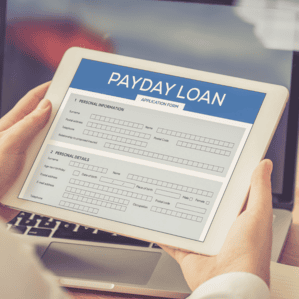
Maternity Leave Payday Loans
A maternity leave payday loan provides you with a lump sum of money that must be repaid in full by the time you receive your next paycheque.
Since you’re on maternity leave and are not currently receiving pay from work, your payday loan repayment would be due the next time you receive your pay from the government. No installment payments are involved. Instead, you’re required to make your payment in full when it’s due.
Payday loans are very expensive, with rates that can work out to the equivalent of nearly 400% APR or more.2 As such, you’ll be paying a lot in interest compared to the principal. You need to make sure that you’ll have the funds needed to fully repay the loan by the time payment is due, including both the original loan amount and interest. If your only income is government support, it also helps to understand how payday loans work with government benefits before you apply.
Maternity Leave Guarantor Loans
These are another loan option and are generally more beneficial to borrowers with bad credit or who are having trouble qualifying for regular loans for whatever reason. In order to get a guarantor loan, you would need to get a trusted friend or family member to co-sign your loan. Ideally, they should have good credit and decent finances (reasonable income, steady employment, etc.). This can be a helpful route if you don’t have traditional pay stubs on leave, similar to loans without employment verification.
The Pros Of Guarantor Loans
- Rather than your own credit being the deciding factor, lenders will take your co-signer’s credit into account. Even if you have bad credit, you should still receive approval.
- You’ll be listed as the primary borrower. This means that with every on-time loan payment, you’ll be working toward improving your credit score.
- Since you have a guarantor, you may receive a better interest rate than you would with most bad credit personal loans.
The Cons Of Guarantor Loans
- As with any loan product, you’ll rack up penalties and potentially affect your credit if you don’t keep up with your payments.
- Choosing an irresponsible guarantor who cannot or does not keep up their side of the agreement will likely cause credit and financial issues for both of you.
What To Look For When Applying For A Maternity Loan
Before applying for a maternity leave loan, consider the following tips to maximize your chances of approval and to get the best deal:
5 Things That Improve Your Maternity Leave Loan Approval
Start Looking Early
If you’re not already on leave, apply while you’re still working. A traditional income boosts your approval odds and gets the money in your account before leave starts.
Do Some Comparison Shopping
Your bank is one option, but an alternative lender may approve you more easily on maternity leave, especially if your credit score is low.
Get Pre-Qualified
Alternative lenders let you pre-qualify with a soft check, so you can see if you’re eligible and what rate you’ll pay before you apply.
Look Out For Additional Fees
Interest is not the only cost. Watch for origination fees, prepayment penalties, and NSF fees, which all add to the total cost of the loan.
Gather All Required Documents
Have your paperwork ready before you apply so nothing stalls your application (see the checklist below).
Benefits And Drawbacks Of A Maternity Leave Loan
Most people don’t realize how expensive it is to have a baby, so some parents may become cash-strapped after having a child. Weigh the benefits against the drawbacks before you borrow.
Benefits
- More money available to help with unexpected baby expenses and medical bills.
- You can take more time off work to bond with and care for your baby.
- Peace of mind knowing you can spend more time with your baby.
- You can spread your baby costs over a longer period of time.
Drawbacks
- You’ll have a new monthly payment to keep up with.
- Lenders that offer maternity leave loans typically charge high interest rates, especially if you have a bad credit score.
- Your credit score can suffer if you’re unable to afford your payments.
Alternatives To A Maternity Leave Loan
A loan is not the only way to cover a shortfall while you’re on leave. Depending on your situation, one of these options may cost you less:
- Employer top-up (SUB plan). Some employers offer a Supplemental Unemployment Benefit that tops up your EI payments for part of your leave. Check with your HR department before you assume EI is your only income.
- An emergency fund. If you saved before your leave, drawing on those funds avoids interest entirely.
- A line of credit or low-rate credit card. If you already have one, it may carry a lower rate than a payday or bad credit loan, and you only pay interest on what you use.
- Government child benefits. Once your baby arrives, benefits like the Canada Child Benefit add to your monthly income and may reduce how much you need to borrow.
- Support from family. A gift or interest-free loan from a relative can bridge a short gap without adding to your debt.
Note: EI Benefits Can Count As Income
You do not need to be back at work to qualify with many alternative lenders. What matters is that your EI maternity or parental benefits are steady and meet the lender’s minimum income requirement. Keep your Service Canada benefit statements handy, since lenders use them to confirm your incoming funds.
What Is Maternity Leave?
Maternity leave represents the time a parent takes off work to nurture and raise their newborn or adopted child. This benefit is provided by the government to employed people who are pregnant, have just given birth, or are caring for a newborn or adopted baby. Eligible parents can get up to 15 weeks off through the maternity benefit, after which they can choose one of the two options below:
Standard Parental Benefits last up to 40 weeks and can be shared by both parents.
Extended Parental Benefits offer up to 69 weeks of benefits, shared between the parents, for those who want extra time to care for their children.
Child Benefits In Canada
Once your baby arrives, you may qualify for several child benefits, and you can even use some of them, such as the Canada Child Benefit, to help qualify for a loan against your child tax benefit:
- Canada Child Benefit (CCB)
- Nova Scotia Child Benefit (NSCB)
- The Newfoundland and Labrador Child Benefit
- The Ontario Child Benefit (OCB)
- Alberta Child and Family Benefit (ACFB)
- Maternity and parental leave benefits
Bottom Line On Applying For A Loan While On Maternity Leave
As you can see, with a loss of income, baby expenses, and the regular daily costs of living, having a baby is an expensive process. Luckily, there are government benefits and personal loans that could help with financing your maternity leave. Just remember, borrowing money can be risky, but with the right guidance, it can be immensely helpful. You should borrow an amount that will cover the extra baby expenses and the lost income. To give yourself the best chance at getting loans on maternity leave, make sure you have a positive credit history, along with at least one current and constant source of income.
FAQs On Applying For A Loan While On Maternity Leave
Can I apply for a maternity leave loan with my spouse or partner?
Yes, many lenders allow you to apply for a loan with a co-signer added to the agreement. You may consider this option if your benefits are insufficient or your credit score is low. If your partner earns an adequate income and has good credit, this will increase the likelihood of loan approval.
Can I borrow from my RRSP while on maternity leave?
Yes, however, it’s important to understand the tax implications of doing so. Withdrawing from your RRSP early means you’ll be taxed on the funds taken out, which could have a financial impact on your retirement savings.
Does the government offer an assistance program for maternity leave?
Yes, the Canadian government offers maternity leave for mothers and parental leave that mothers and fathers can share. Your position at work will be held for you until you return to work following maternity leave. Quebec residents receive benefits under a separate plan that offers similar benefits to parents.
Who can benefit from a maternity leave loan?
All parents can benefit from maternity leave loans, including birth parents, surrogate mothers, and adoptive parents. With a smaller income and additional baby costs, it can be a struggle for families to keep up with daily finances, especially those already struggling. With a maternity leave loan, both parents can have peace of mind. A loan will provide a chance for one of the parents to remain home and nurture the child.
References
- Government of Canada. (2026). EI maternity and parental benefits: How much you could receive. https://www.canada.ca/en/services/benefits/ei/ei-maternity-parental/benefit-amount.html
- Financial Consumer Agency of Canada. (2026). Payday loans. https://www.canada.ca/en/financial-consumer-agency/services/loans/payday-loans.html