


Key Points
1. Quebec’s general minimum wage rose to $16.60 per hour on May 1, 2026 — a 50-cent (3.11%) increase affecting roughly 258,900 workers across the province.
2. Tipped employees now earn at least $13.30/hr, and federally regulated workers in Quebec earn $18.15/hr (effective April 1, 2026) since the federal rate exceeds the provincial one.
3. A full-time minimum-wage worker grosses about $34,528/year (~$28,140 after tax) — still roughly $755 short of Montreal’s monthly cost of living for a single person.
4. If your employer fails to apply the new rate, you have up to one year to file a free wage complaint with CNESST.
What Changed On May 1, 2026?
As of May 1, 2026, Quebec’s general minimum wage is $16.60 per hour — a 50-cent (3.11%) increase from the previous $16.10 rate. The change affects roughly 258,900 workers across the province and adds about $687 in gross annual pay for a typical full-time minimum-wage earner. It’s the largest single-year lift since 2023.
Quebec’s increase is part of the broader 2026 minimum wage cycle across Canada, which also includes scheduled adjustments in British Columbia, Ontario, and Nova Scotia.
Quebec minimum wage (2026): Quebec’s general minimum wage is $16.60 per hour as of May 1, 2026, set by the Commission des normes, de l’équité, de la santé et de la sécurité du travail (CNESST). Tipped workers earn $13.30 per hour. Federally regulated employees earn at least $18.15 per hour as of April 1, 2026.
2026 Quebec Minimum Wage Rates
| Worker category | 2025 rate | 2026 rate (effective May 1) |
|---|---|---|
| General minimum wage | $16.10/hr | $16.60/hr |
| Tipped employees | $12.90/hr | $13.30/hr |
| Strawberry pickers (per kg) | $1.27/kg | $1.32/kg |
| Raspberry pickers (per kg) | $4.75/kg | $4.93/kg |
| Federally regulated workers* | $17.75/hr | $18.15/hr (since April 1, 2026) |
*Federally regulated industries include banking, telecommunications, broadcasting, and interprovincial transportation. Where the provincial rate is higher, employers must pay the higher of the two.
Annual Earnings On Minimum Wage
A full-time Quebec worker earning the new $16.60/hr minimum wage and working 40 hours per week, 52 weeks per year, will gross approximately $34,528 annually. After federal and Quebec provincial income tax, CPP/QPP, EI, and QPIP contributions, take-home pay works out to roughly $28,140 per year — about $2,345 per month.
That’s an increase of around $1,040 in gross pay (or ~$835 net) compared with the previous $16.10 rate.
Can You Live On Minimum Wage In Quebec?
Short answer: not comfortably, especially in larger cities.
Montreal — single person. According to Numbeo, living solo in Montreal in 2026 costs roughly $3,100 per month, including median rent (~$1,871), utilities, internet, groceries, and transit. A minimum-wage take-home of $2,345/month falls about $755 short — meaning a full-time minimum-wage earner cannot comfortably cover Montreal’s cost of living without roommates, a second income, or government support.
Quebec City — family of four. A family of four in Quebec City spends roughly $4,874 per month before rent on groceries, utilities, transportation, and other essentials (Numbeo, March 2026). Two full-time minimum-wage earners net about $4,690/month combined — still below the family’s pre-rent baseline, before housing is added.
Stretching a minimum-wage income takes deliberate planning. Two starting points worth bookmarking:
- How to make a monthly budget in 2026 — the 50/30/20 framework adapted for Canadian households.
- How to get out of debt on a low income — debt strategies when every dollar is already accounted for.
How Minimum Wage Compares To The Average Income In Quebec
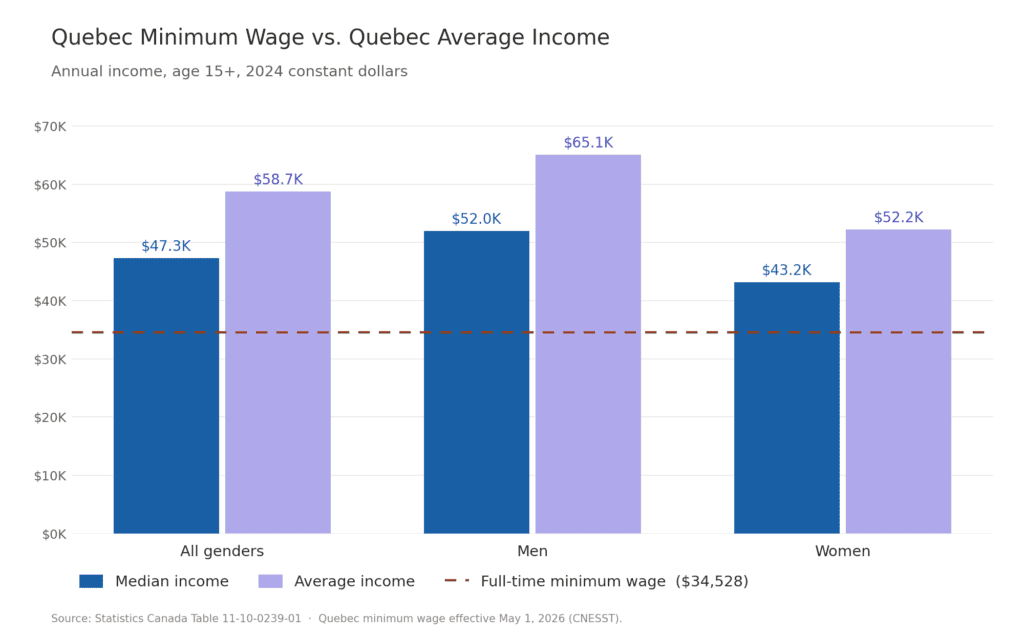
This chart compares Quebec’s minimum wage to what most people in Quebec actually earn.
If you work full-time at minimum wage in Quebec, you make about $34,500 a year. That sounds like a lot — but it’s less than what most Quebecers earn.
- The typical (median) Quebecer makes around $47,300 a year
- The average Quebecer makes about $58,700 a year
- Men typically earn more ($52,000) than women ($43,200)
Minimum wage isn’t really a “normal” salary — it’s the lowest amount your boss is allowed to pay you. Even working full-time all year long, you’d still be earning a lot less than most working Quebecers.
Note: The median wage is usually a fairer picture of normal life since it’s not skewed by the ultra rich.
Learn more: Average income in Canada
How Has Quebec’s Minimum Wage Changed Since 2016?
Since 2016, Quebec’s minimum wage has climbed $5.85 — from $10.75/hr to $16.60/hr — a 54.4% increase over a decade.
| Year (effective May 1) | Minimum wage | Change |
|---|---|---|
| 2016 | $10.75 | — |
| 2017 | $11.25 | +$0.50 |
| 2018 | $12.00 | +$0.75 |
| 2019 | $12.50 | +$0.50 |
| 2020 | $13.10 | +$0.60 |
| 2021 | $13.50 | +$0.40 |
| 2022 | $14.25 | +$0.75 |
| 2023 | $15.25 | +$1.00 |
| 2024 | $15.75 | +$0.50 |
| 2025 | $16.10 | +$0.35 |
| 2026 | $16.60 | +$0.50 |
How The Minimum Wage Is Affected By Inflation
Quebec’s minimum wage went up a lot since 2016 — from $10.75 to $16.60 an hour. That sounds like a big raise! But here’s the catch: stuff also got more expensive. Bread, milk, rent, everything.
So even though workers are taking home bigger paychecks, those paychecks don’t buy much more than they did 10 years ago. It’s like getting more allowance, but candy costs more too — so you’re not really getting more candy.
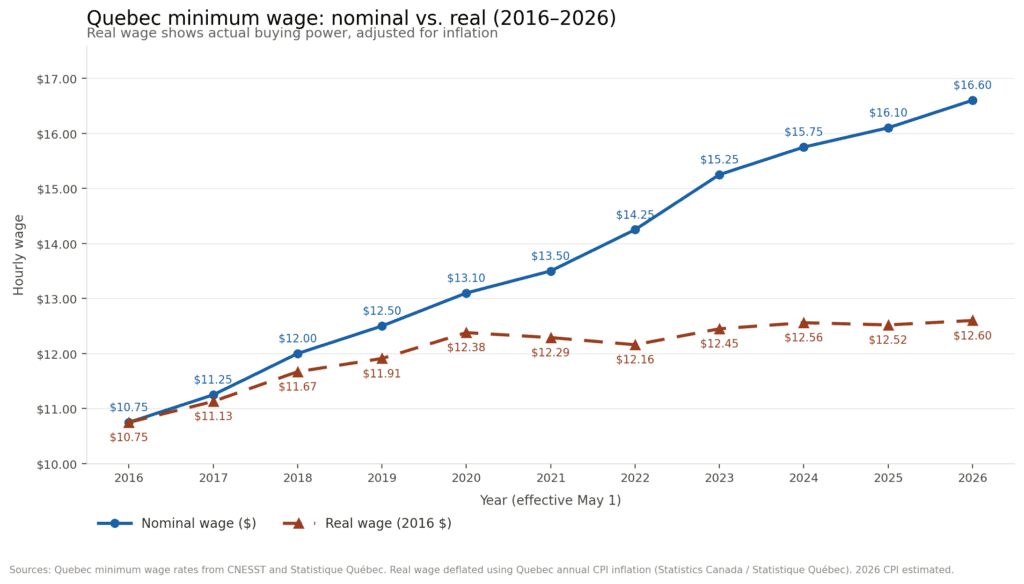
The most telling moment is 2021–2022, when prices spiked faster than wages could keep up. Even with annual raises, minimum-wage workers could buy less than the year before. So while the headline number keeps climbing, what your paycheck can actually afford has barely budged.
Tipped Employees And Agricultural Workers
Tipped employees. Workers who customarily receive tips — typically restaurant servers and bartenders — must be paid a minimum of $13.30 per hour as of May 1, 2026, up from $12.90. Tips received from customers do not reduce the employer’s obligation to pay this base rate.
Strawberry and raspberry pickers. Pieceworkers in Quebec’s berry fields are paid by weight rather than by hour:
- Strawberry pickers: $1.32 per kilogram (up from $1.27)
- Raspberry pickers: $4.93 per kilogram (up from $4.75)
If piece-rate earnings fall below the equivalent of the general minimum wage in a pay period, the employer must top up the difference.
Curious About The Minimum Wage Across Canada?
- Minimum Wage Ontario
- Minimum Wage Quebec
- Minimum Wage Alberta
- Minimum Wage British Columbia
- Minimum Wage Manitoba
- Minimum Wage Saskatchewan
- Minimum Wage Yukon
- Minimum Wage Nunavut
- Minimum Wage Newfoundland & Labrador
- Minimum Wage PEI
- Minimum Wage Nova Scotia
- Minimum Wage New Brunswick
- Minimum Wage Northwest Territories
Federally Regulated Workers In Quebec
Employees in federally regulated industries — banking, telecommunications, broadcasting, postal services, interprovincial trucking, rail, marine, and air transportation — are covered by the federal minimum wage rather than Quebec’s provincial rate. These are the industries overseen by Employment and Social Development Canada (ESDC).
Federal rate beats provincial in Quebec
The federal minimum wage rose to $18.15 per hour on April 1, 2026 (up from $17.75) — a 2.1% CPI-based adjustment. Because $18.15 exceeds Quebec’s $16.60 provincial rate, federally regulated employers in Quebec must pay the federal rate, not the provincial one. That’s a $1.55/hour premium worth roughly $3,224 in extra gross pay annually for a full-time worker.
Wage payment, deductions, and overtime rules {#rules}
Payment intervals. Employers must pay wages at intervals of no more than 16 days, except for the first paycheque of a new hire (which can be issued up to one month after the start date).
Allowable deductions. Employers may only deduct from your pay:
- Government-required withholdings — income tax, Quebec Pension Plan (QPP) or CPP, EI, and QPIP
- Reasonable charges for meals and lodging if provided
- Specialized work clothing, only if you’ve agreed in writing
Employers cannot deduct for cash-register shortages, breakage, customer walkouts, or uniform purchases beyond specialized work clothing.
Overtime. The standard work week in Quebec is 40 hours. Hours worked beyond that are paid at 1.5× the regular rate (or, by mutual agreement, banked as paid time off at 1.5× the hours worked).
You have the right to refuse overtime that exceeds:
- 4 hours beyond your normal daily hours, or
- 14 hours total in any 24-hour period
- 50 hours total in a 7-day period (varies for some occupations)
How To Verify Your May 1 Paycheck
If you earn at or near minimum wage, take three minutes after your first May pay period to confirm your employer applied the increase correctly:
- Check the hourly rate on your pay stub. It should show $16.60 per hour (or $13.30 if you’re a tipped worker, or $18.15 if you work in a federally regulated industry). Pay stubs that still show the old rate after May 1 are a payroll-system error.
- Confirm the rate applies to all hours worked from May 1 onward. If your pay period straddles May 1 (for example, April 27 to May 10), the new rate applies only to hours worked on and after May 1; earlier hours can stay at $16.10.
- If you’ve been short-paid, raise it with your employer first. Most cases are payroll-system oversights and are corrected in the next pay run. If your employer refuses to fix it, you can file a wage complaint with CNESST within one year of the underpayment. There is no fee to file.
Tipped workers should also confirm that their base hourly rate is at least $13.30 — tips are on top of that floor, not a replacement for it.
If a wage shortfall has stretched your finances, Quebec’s social assistance program may help bridge the gap while your CNESST complaint is resolved.



Quebec Minimum Wage FAQs
When did Quebec’s minimum wage go up to $16.60?
How much does a full-time minimum wage worker earn in Quebec per year?
What is the minimum wage for tipped employees in Quebec in 2026?
Is Quebec’s minimum wage a living wage?
When will Quebec’s minimum wage increase next?
What should I do if my employer doesn’t pay me the new $16.60 rate?
References
Commission des normes, de l’équité, de la santé et de la sécurité du travail. (2026). Minimum wage in Québec: $16.60 per hour. Government of Québec. https://www.cnesst.gouv.qc.ca/en/working-conditions/wage-and-pay/wages/minimum-wage
Employment and Social Development Canada. (2026, March 24). Government of Canada raises the federal minimum wage. Government of Canada. https://www.canada.ca/en/employment-social-development/news/2026/03/government-of-canada-raises-the-federal-minimum-wage.html
Institut de la statistique du Québec. (2026). Minimum hourly wage, Québec, 1997–2026. Government of Québec. https://statistique.quebec.ca/en/produit/tableau/minimum-hourly-wage-quebec