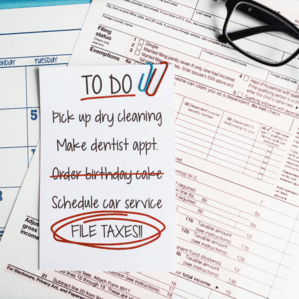

An annual tradition, filing taxes is akin to spring cleaning. You might wonder where the year went. Maybe you had a baby, got married, got divorced, got laid off… When you file your taxes, it is time to reflect on everything and anything from the past year that impacts your tax bill.
Despite the complexity, it remains essential to file (and pay) your taxes on time. Of course, to do that, you need to know when to file. The deadline for filing is different depending on your situation. To help you better understand when to file your 2025 taxes, we’ve broken down the specifics for the most common situations. Let’s take a look.
Key Points:
- The deadline for filing an individual tax return and paying any amount owing is April 30, 2026.
- Self-employed individuals and their spouses have a later filing deadline of June 15, 2026.
- A late filing penalty includes 5% of the amount owing, plus an additional 1% for every subsequent month.
- For the 2025 tax year, the Basic Personal Amount (BPA) is $16,129, which is the amount of income that is tax-free for most workers.
When Can I File My 2025 Taxes In Canada?
Your tax deadline varies based on the type of tax return you’re filing. Typically, any amount owing becomes due and payable on the deadline date. To avoid interest, knowing which category represents your return (and to file on time) is important.
Individual Tax Return Deadline
The last day to file taxes is Wednesday, April 30, 2026. Unless you have made other arrangements with Revenue Canada, this is the day any amount owing becomes due. After this time, it will begin to accrue interest.
Self-Employed Tax Return Deadline
Those who are self-employed have a later deadline, the last day to file is June 15, 2026. The deadline also applies to the spouses of self-employed individuals.
Due Dates For Tax Installment Payments
If you arrange to pay portions of your tax bill throughout the year, the payments must be submitted quarterly. The due dates are March 15, June 15, September 15, and December 15. Failure to meet these deadlines results in needing to pay a higher amount. This applies to both employed and self-employed individuals.
Due Dates For Final Tax Returns
This applies to those who are representing the estate of a deceased person. Let’s say you are the Executor of a will. As Executor, you must complete the final tax return of the deceased.
If the person died before October 31, 2025, the deadline for the final return is April 30, 2026. If the person died between November 1st and the end of the year, the return is due six months after the death occurred.

File your taxes with TurboTax
Get StartedWhat Happens If You Miss The Tax Deadline In Canada?
Missing a deadline is never a good thing — but missing your tax deadline is possibly the worst deadline to miss. In addition to the extra stress you face from racing the clock, filing your taxes late comes with costly expenses.
Late Tax Filing Penalty
If you miss your tax deadline, then Revenue Canada will charge you five percent of any amount owing. Every subsequent month, an additional one percent is added to the total. For those who are late filing for previous years, the penalty increases to ten percent upfront and an additional two percent every month. The maximum penalty period is 20 months.
Example: If you owe $2,000 on your income tax bill and you file two months late, you will get a late penalty of $100 (five percent of the total). If you pay the full amount within the month, you will owe $2,100.
Were you to pay three months late, the added penalty would increase. One percent of $2,000 is $20. It gets added to the total every month, raising the amount to $2,160.
Are you struggling to pay your taxes? Find out if bankruptcy is the right solution for your tax debt.
How To Prepare For The 2025 Tax Season: Your Checklist
To ensure smooth and accurate tax filing, be sure to gather all necessary documents before you start. Missing key slips or records can lead to missed deductions or delays in processing your return.
Essential Documents to Gather
Before you file your 2025 income taxes in Canada, don’t forget to have the following documents ready:
- Income Slips: Collect all relevant slips, such as:
- T4 (employment income)
- T4A (pension or other income)
- T5 (investment income)
- T4E (EI benefits)
- T5008 (securities transactions)
- Receipts For Deductions & Credits: Gather receipts for deductible expenses like:
- Child care
- Medical costs
- Moving expenses (if eligible)
- Charitable donations
- Investment & Retirement Information: Documents relating to your RRSP contributions (deadline March 2, 2026) and any capital gains or losses from investment accounts.
- Self-Employment Records: If you are self-employed, you will need a meticulous record of all business income and expenses.
Maximizing Your 2025 Tax Refund: Key Credits & Benefits
A major goal when filing your income taxes is to maximize your return. This involves claiming all applicable tax credits and deductions.
Non-Refundable Tax Credits
These credits reduce the amount of tax you owe, but you won’t get a refund if the credit is greater than your taxes payable. The Basic Personal Amount (BPA) is the largest non-refundable credit, set at $16,129 for most workers in 2025.
| BPA Increase For 2026 When you file your taxes next year (your 2026 taxes), the Basic Personal Amount for most workers will increase to $16,4521. |
Refundable Tax Credits
These credits can result in a refund even if you owe no tax. One of the most important is the GST/HST Credit, which is paid out quarterly to help low- and modest-income individuals and families offset the GST/HST they pay. Understanding the payment dates for this credit is crucial for financial planning.
| Changes Coming To The GST/HST Credit The GST/HST credit will move to the Canada Groceries and Essentials Benefit beginning in July 2026, boosting payments by 25% for 5 years, with a one‑time top‑up equal to 50% of your 2025-2026 annual amount issued by June 20262. |
Choosing The Best Tax Software In Canada For 2025
While mailing in paper returns is still an option, most Canadians choose to file online using tax software, which is integrated with NETFILE. Choosing the right software can simplify the process, minimize errors, and help maximize your refund.
Top tax filing software options in Canada include the following:
- TurboTax: Best for all-around use, offering a guided process and an auto-fill feature to import CRA data. They offer a free option for simple personal returns.
- Wealthsimple Tax (SimpleTax): The best budget-friendly option, known for its sleek interface and a donation-based basic plan that includes capital gains and rental income.
- H&R Block: Excellent for those who want the option of in-branch support, though in-person help is often an extra charge. They offer free filing for simple returns and for those 25 and under.
- UFile: A straightforward option with a triple accuracy guarantee. They offer free filing for students and low-income families.
- StudioTax: Best for secure, offline filing. It’s compatible with all Canadian provinces and offers a free version for those earning $20,000 or less.
| Pro Tip: When making your choice, look for NETFILE-certified status, auto-fill functionality, clear pricing, and customer support. |
Ways To File Your Taxes In Canada For The 2025 Tax Season
There are multiple ways to file your taxes, thanks in large part to evolving tax software. You can choose whichever option you’re most comfortable with, be that on paper or online. Options include:
- Filing Online Using Software: Using either EFILE or NETFILE, you can file your taxes online. EFILE is used by tax professionals working on your behalf. NETFILE is the program approved by Revenue Canada that lets you file your taxes. NETFILE is integrated with most mainstream tax software programs available.
- Voluntary Tax Clinics: The Community Volunteer Income Tax Program has clinics throughout the country, meant to help those with lower income and basic tax returns. Experienced tax professionals facilitate the returns.
- Mail-In Paper Returns: If you are more comfortable with the traditional way of filing taxes, you can still do your taxes on paper and mail them to the CRA. You can order the paperwork online or download it and print off the documents.
- CRA File My Return Service: A service available for low-income individuals, it lets you file your taxes using the automated phone service. Those who qualify will receive paper correspondence from Revenue Canada to inform them of this program’s availability.
Tax Changes For Next Year’s Tax Season You Should Know About
Given the fluctuating nature of all the details associated with filing your income taxes in Canada. It’s important to stay up to date with all the latest tax news so you can file your taxes quickly and without any surprises.
The Basic Personal Amount (BPA) Is Higher
The Basic Personal Amount for 2026 for most workers is $16,452. This means te government will not tax you on the first $16,452 that you earned, depending on the tax year.
The Federal Tax Brackets Have Changed
One good thing to come out of life getting that much more expensive is this: the federal tax brackets have shifted so that you might catch a break. These brackets also affect your provincial tax rate.
The first $16,452 of income you earn is tax-free (for the 2026 tax year). It is your Basic Personal Amount. These adjusted tax brackets apply to any taxable income you have. That means anything over the BPA.
| Federal Tax Rate 2026 | Federal Income Tax Bracket 2026 |
| 14% | Applicable to the first $58,523 of taxable income |
| 20.5% | Applicable to taxable income over $58,523 to $117,045 |
| 26% | Applicable to taxable income over $117,045 to $181,440 |
| 29% | Applicable to taxable income over $181,440 to $258,482 |
| 33% | Applicable to taxable income over $258,482 |
Canada Pension Plan Maximum Contributions Are Higher
The maximum pensionable earnings for the Canada Pension Plan (CPP) for 2026 is $74,600, and the basic exemption is $3,500 in 2026.
TFSA Limit Went Up
The annual limit on tour Tax Free Savings Account (TFSA) is higher. If you have had a TFSA since the beginning (2009) and never made a deposit, your eligible amount is a maximum of $109,000. The yearly contribution limit for 2026 is $7,000.
RRSP Limit Increased
You still can only contribute 18% of your annual income to your registered retirement savings plan (RRSP). However, there is a maximum amount that any Canadian, regardless of income, can put in their RRSP. This year, the maximum is $33,810 for 2026.

When Will You Get Your Tax Refund?
If you electronically file your taxes before the deadline, the CRA will generally provide your tax refunds within 2 weeks. However, if you file by paper, your tax refund can take up to 8 weeks to reach you. Do keep in mind that these numbers are estimates and the CRA does not guarantee you will receive your refund within the period mentioned. Moreover, if the CRA requires additional information or if you’re getting audited, your refund may be delayed further.
FAQs
What happens if the tax due date falls on a holiday or weekend?
Do I have to file my taxes?
What’s the deadline for my RRSP contributions?
How do I pay my taxes?
What happens if I don’t get my T4 slip on time?
References:
1Government of Canada. Payroll Deductions Tables – CPP, EI, and income tax deductions – Ontario. Canada.ca
2Government of Canada. GST/HST credit. Canada.ca